Showing posts with label gardening. Show all posts

Thursday, December 1, 2011

Beauty of the Winter Garden

Winter shows our northwest landscapes at their worst. Most plants have gone to sleep (dormant) in the winter and therefore look somewhat lifeless.  However, our gardens may be resting, but, they should not look dead.
Winter is  when the structure of your landscape is tested.  If it passes the test, then there should be at least an occassional shrub or perennial in bloom, some interesting bark to draw  attention, berries hanging on throughout the season, songbirds occasionally if we feed them, and greenery to remind us that things are still alive.
Winter, of coarse, is when most of us observe our gardens from inside or passing to and from our homes.  Every window can be a picture if time is spent designing a potrait of nature.  Curb appeal is extremely significant during this season of the year.

Landscape Plan
We can make a landscape plan so that even in the winter, your garden will look alive and therefore have a wonderful appearance. Wouldn’t it be nice to entertain for the holidays where every window is a picture frame of an artistic landscape? If it looks great in the winter, your garden retreat will be fabulous during the growing seasons of spring and summer.

With your landscape plan completed in the winter, you’ll be able to start working on parts of the project as winter weather permits. When spring approaches, you’ll be ready with plan in hand to complete your landscape work with enough time left in the growing season to enjoy and use your garden retreat.


Many garden plants — from tough shrubs to annual bedding plants — provide welcome color throughout the winter. Check out these favorite cold-weather beauties for some inspiration.


There's no need to wait till spring for outdoor flowers: grow a few of these winter-blooming perennials and shrubs in your backyard.


Add pops of color to your winter landscape with plants and shrubs that add interest and will attract and support wildlife.
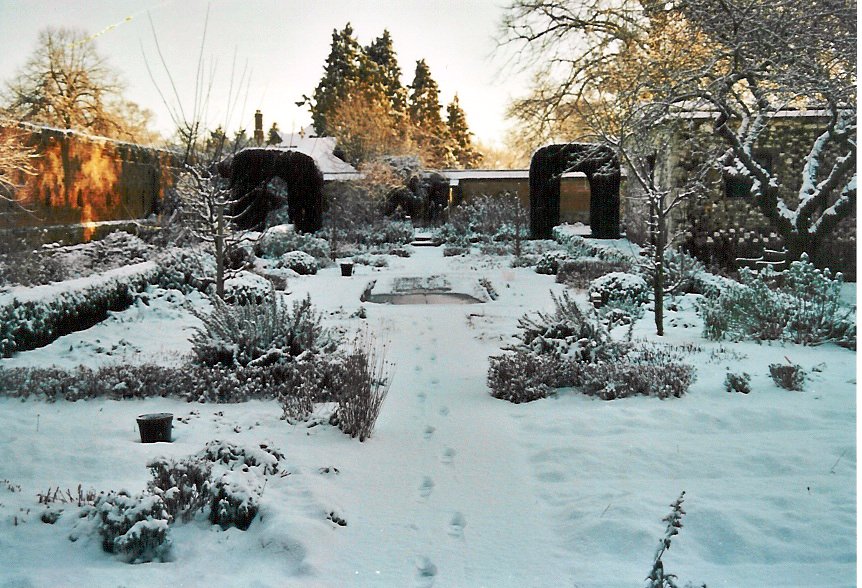


Liven up a drab winter yard with these tips for adding color and interest.


Tuesday, November 22, 2011

Design and Build Your Own Aquaponics System

Aquaponics is a revolutionary system for growing plants by fertilizing them with the waste water from fish in a sustainable closed system. A combination of aquaculture and hydroponics, aquaponic gardening is an amazingly productive way to grow organic vegetables, greens, herbs, and fruits, while providing the added benefits of fresh fish as a safe, healthy source of protein. On a larger scale, it is a key solution to mitigating food insecurity, climate change, groundwater pollution, and the impacts of overfishing on our oceans.


Aquaponic systems vary in size from small indoor or outdoor units to large commercial units, using the same technology. The systems usually contain fresh water, but salt water systems are plausible depending on the type of aquatic animal and which plants.


Function

Aquaponics consists of two main parts, with the aquaculture part for raising aquatic animals and the hydroponics part for growing plants. Aquatic effluents resulting from uneaten feed or raising animals like fish, accumulates in water due to the closed system recirculation of most aquaculture systems. The effluent-rich water becomes toxic to the aquatic animal in high concentrations but these effluents are nutrients essential for plant growth. Although consisting primarily of these two parts, aquaponics system are usually grouped into several components or subsystems responsible for the effective removal of solid wastes, for adding bases to neutralize acids, or for maintaining water oxygenation. Typical components include:
  • Rearing tank: the tanks for raising and feeding the fish;
  • Solids removal: a unit for catching uneaten food and detached biofilms, and for settling out fine particulates;
  • Biofilter: a place where the nitrification bacteria can grow and convert ammonia into nitrates, which are usable by the plants;
  • Hydroponics subsystem: the portion of the system where plants are grown by absorbing excess nutrients from the water;
  • Sump: the lowest point in the system where the water flows to and from which it is pumped back to the rearing tanks.
 
Depending on the sophistication and cost of the aquaponics system, the units for solids removal, biofiltration, and/or the hydroponics subsystem may be combined into one unit or subsystem, which prevents the water from flowing directly from the aquaculture part of the system to the hydroponics part.


Design your own Aquaponics System

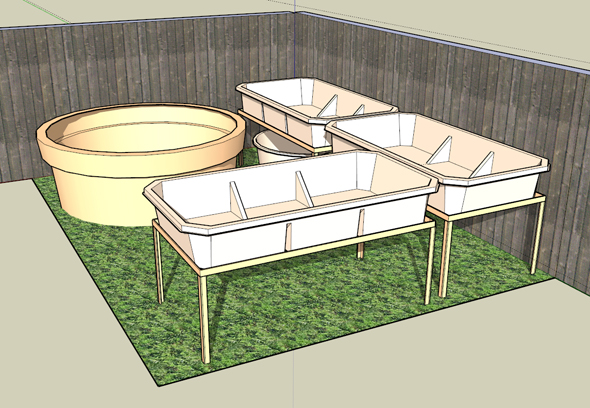
Have you got a great idea for an aquaponic system? Want to design your own system or see how one of systems will look in your area?

Google Sketchup is a fantastic tool to use for simple 3D design, and almost anyone can use it without after just a few minutes experimenting.


Make your own in seven step

First step: dig a hole for the fish tub to go into , ensure that your fish tub has some shade to avoid evaporation and is also below ground level to maintain a good steady water temperature.

The second step: run a 10 metre long outdoor/waterproof extension cable from my shed to the fish area and connect the pump and the air pump to the power outlet. I then places all leads and sensitive electrical parts in a waterproofed box and buried it in a small hole that was easily accessible to me.

The third step is to drill or make some holes in the bottom of your growtub so that that the water can drain out back into the fish tub next thing is to setup a place for the grow tub to sit preferably close as possible to the fish tub as this way the pump wont have to work as hard to get the water into the grow tub from the fish tub.
For my example setup I simply placed the the grow tub at a higher level than the fish tub and let gravity control the water flow back down into the fish tub with the help of a basic roof tile.

The fourth step was to connect a hose from the 1000L pond pump to the grow tub and set it up with the digital power timer to control when i wanted the pond pump to turn on and off.

The fifth step was to then fill the fish tub with dechlorinated water and fish and run a few trial runs to see if the water flowed from the fish tub to the grow tub and back out correctly. At this point its a good idea to monitor how fast the water is escaping as this will slow down a lot after you add your grow medium

The seventh step was to wash the gravel and then add the gravel into the growtub (make sure your happy with the location as it gets extremely heavy and impossible to move) . From here you can simply drop some seeds into the grow tub and cover lightly with gravel and wait for germination to occur. When you first put the seeds in you will have doubts that the plants will even come up but be patient and you will see plenty of little seedlings otherwise you can always add plants transplanted from a dirt garden. Germination is always faster in hotter weather.

Here are just a few of the fish species for your Auquaponic systems

  • Talapia
  • Rainbow Trout
  • Brown Trout
  • Silver Perch
  • Jade Perch
  • Sleepy Cod
  • Murray cod
  • Barramundi
  • Yabby
  • Crayfish
  • Redclaw

Sunday, November 6, 2011

Decorative Plants

Paulownia tomentosa
Description: Very ornamental tree native to eastern Asia, was named after Anna Pavlovnoj (1795 - 1865), daughter of Tsar Paul I Petrovich Romanov. It features many beautiful flowers in spring. Appreciated the honey and industrial type.


Impatiens balsamina
Description: Impatiens balsamina  is an annual herbaceous plant. Height of 20-60 cm. The flowers beneath sheets of different colors. It is used in planting gardens in lei. It is produced by direct sowing in the second half of April, or from seedlings (planting in May). Flower gradually from mid June to early August.


 Passiflora caerulea
Description: Passiflora caerulea is the only one that is grown in the apartment. Flower bluish purple. It is best grown in a pot Pasifloru, even if it is buried in the ground, to limit the growth of the root system and encourages heavier flowering. Size: can easily grow to 3 meters in height and about 2 meters. Time of flowering: during the summer. Very easily grown.


Washingtonia palm
Description: Belongs to Arecaceae family, originated from in south California, east Arizona and Mexico.
It has evergreen leaves, big and post like single trunk, the base is bigger than other part of the trunk.
Recently, Washington palm is recognised as one of the most popular trees in landscaping of gardens and roads. The good artificial washington palm is even more widely used inside the big buildings for decoration.


Pink Phalaenopsis Orchid with Large Blooms
Description: The Phalaenopsis or the elegant Moth orchid is one of the most beautiful with fleshy leaves and flowers in a huge range of colors. The Phalaenopsis orchid is becoming more and more popular as a houseplant due to their ease of culture and to their beautiful, long-lasting flowers. Modern Phalaenopsis orchid hybrids are very colorful and some are fragrant as well. The wedding favorites are large white Phalaenopsis orchid flowers with yellow in the lip. For all of these, the orchid flowers will last for several months with the proper care. The Phalaenopsis orchid originated from the jungles of South Asia, Southeast Asia, as well as East Asia.

Cerise Phalaenopsis Orchid with Large Blooms


                                       Wild Deep Pink Lily
Description:The bulb is usually the most distinguishing characteristic. It is composed of fleshy scales without a protective outer coating. A true lily is never dormant ... it must be considered and treated as a living perennial plant. Lily bulbs may be kept in cool storage for a few months, but special care must be taken to keep them fresh and moist. Lily flowers, though completely varied in size, shape and color, always have six tepals and six anthers. Stems, leaves and roots have distinguishing features too.


 Red Three Heads Wild Poppy
Description: Gardeners who love the silken flowers that characterize all the members of the poppy family (Papaveraceae) will find a great variety obtainable today. Poppies are invaluable for bringing bright color to the garden in early summer. Poppies are a diverse group of flowers with annuals, biennials and perennials in their ranks.


Tall Yellow Buttercup
Descriptions: Since its introduction from Eurasia, tall buttercup has become widespread throughout the U.S., excluding an area between central Montana and eastern Minnesota. It can be found in a variety of habitats, including wet lowlands and rich woodlands and is a common weed in pastures, meadows, and along roadsides. It usually does not persist in cultivated fields. Tall buttercup prefers heavy, moist soils.


Blue Japanese Anemone
Description: These late-summer-blooming perennials are hardy in zones 4 to 8. The flower stems can be up to forty-eight inches long. The flowers are often white, red, or pink and more rarely blue or yellow. The fern-like foliage spreads twelve to eighteen inches with about the same height.


A Red Velvety Rose
Descriptions: Type : Groundcover , Flower Colour: dark red, Fragrance: None detectable, Flowering Period: late spring to frost, Foliage: Glossy, Medium size foliage, Medium green, Plant Height (cm Approximately): 60, Plant Width (cm Approximately): 80, Use: Borders, Mixed Planting, Large Beds, Containers, Full Standard, Half Standard, Special Instructions: Keep in Shape Only


Spray of Mini Pink Roses

Open rose in Shades of Dark Blue

Saturday, November 5, 2011

Growing Your Own Fresh Flowers This Summer


                Gardening


Growing Your Own Fresh Flowers This Summer

When it comes to great summer flowers, just about anybody can go to the store and buy some that are ready to be displayed in their house, but there’s a certain satisfaction that comes from planting and raising your own flowers for the summer season. Here are a handful of tips to keep in mind when planting your own summer flowers this season.

Take the time well ahead of when you plan to plant the seeds to really prepare the soil you’re going to use. Make sure to dig about six inches deep and give the soil a good turning over, and then be sure to add fertilizer, mulch, or compost to really get the nutrients into the soil that your flowers are going to want.
Doing this ahead of time ensures that when you are ready to plant you don’t have to worry about the soil not being ready, or having to spend extra hours preparing it and then planting your flowers. A little preparation can save you a huge amount of time later.

Plant by Size

If you’re planting your flowers against a wall, make sure to plant the taller ones (like sunflowers) back against the wall, with the smaller ones further away from the wall. If you’re planting your garden in the middle of an open space, you’ll want to plant the taller ones in the center, with the smaller ones radiating out from there.
These two configurations allow for all of the plants to get enough sunlight without having to compete with each other and insures that all of your flowers will be visible to both you and anybody else that might be enjoying your garden.

Plant Plenty

To help compensate for losses to insects and birds, plant the seeds closer than recommended on the package, as well as planting more than you expect to grow. Weather, wildlife, and any variety of other causes can leave you with far fewer plants than you put into the ground, and planting extra means you don’t have to worry about a sparse garden when everything blooms.

Be Colorful!

With so many summer flowers out there – sunflowers, petunias, marigolds, and cosmos just to name a few – there’s no reason that your summer garden should be anything less than a bright spot of color for your home. Don’t limit yourself to one type of flower or one color scheme, mix and match and brighten up your garden, lawn, or backyard with bright and colorful summer flowers that are sure to be a pleasure for you and your family to enjoy all season long.

Have Fun

The most important part of planting your garden this summer season is to make sure you have fun with it. Plant lots of flowers, plant more than one garden, get your family involved, get your neighbors involved, plant in patters – whatever you want to do to make sure that your flowers are something that you enjoy from the moment you start turning the soil to when you sit back and watch them bloom.